22%
CBS:Mr. Bush’s approval rating [22%] equals the lowest ever achieved by a sitting president, and is matched only by President Truman in 1952. His 72% disapproval rating is a new high that has never been equaled.

He’s done. He’s through. … He will now go down in history…as an ineffectual leader. And I’ll tell you the reason why, it’s poor leadership on his part. The people that he picked to run certain things have been disastrous. And no leadership and now Americans are getting hurt.
LISTEN HERE
After falling to a record full-month low in May, George W. Bush’s report card from the American people fell even further during the first week of June.
For the seven days ending June 7, just 31% approved of the way the President is performing his job. Sixty-seven percent (67%) disapproved. Both figures are records.
Those figures include just 12% who Strongly Approve of the President’s performance. Four times as many—48%--Strongly Disapprove.
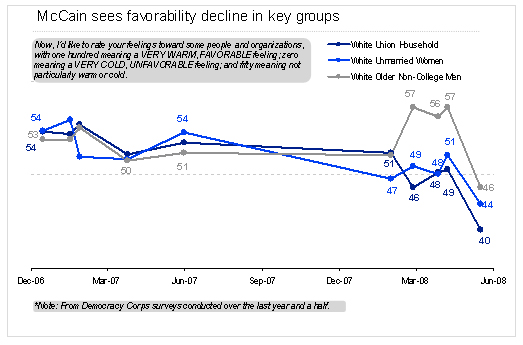
In March, MccCains favorability rating was 49%-27%. Later that month, it was 45%-25%. In April, it was 40%-30%. And now in our latest NBC/WSJ poll, it’s 39%-34% -- that’s a drop of 10 points.
AP: The Supreme Court ruled Thursday that foreign terrorism suspects held at Guantanamo Bay have rights under the Constitution to challenge their detention in U.S. civilian courts. The justices handed the Bush administration its third setback at the high court since 2004 over its treatment of prisoners who are being held indefinitely and without charges at the U.S. naval base in Cuba.Human rights groups have blasted Gitmo. There is ample evidence for torture. This year's Oscar Award winning documentary Taxi to the Dark Side chronicles the Bush Administration's policy of torture and rendition which apply to Impeachment Articles XVII, XVIII, XIX, and XX.
Justice Anthony Kennedy, writing for the court, said, "The laws and Constitution are designed to survive, and remain in force, in extraordinary times." The court said not only that the detainees have rights under the Constitution, but that the system the administration has put in place to classify them as enemy combatants and review those decisions is inadequate.

When Jefferson, in his letter of May 5, 1817, condemned the "den of the priesthood" and "protestant popedom" represented by Massachusetts' state-supported church, he was speaking for both of them--the North and South poles of the revolution. Yet John McCain, even with the GOP nomination in hand, would never dare repeat his brave but politically foolhardy condemnation of the religious right in 2000 as "agents of intolerance." Why? Because we have become an intolerant nation, and that's what gets you elected.And as a result you have this kind of shit in politics as Hirsh points out:
We must endure "lapel-pin politics" that elevates the shallowest sort of faux jingoism over who's got a better plan for Iraq and Afghanistan. We have re-imported creationism into our political dialogue (in the form of "intelligent design"). Hillary Clinton panders shamelessly to Roman Catholics, who have allied with Southern Protestant evangelicals on questions of morality, with anti-abortionism serving as the main bridge.
In Bush there seems little trace left of the Eastern WASP sensibility into which he was born and educated, and which explains so much of his father's far more moderate presidency. The younger Bush went to Andover, Yale and Harvard, but he rebelled against the ethos he learned there. The transformation is complete, right down to the Texas accent that no one else in his family seems to have.
WASHINGTON — President Bush has set a record he'd presumably prefer to avoid: the highest disapproval rating of any president in the 70-year history of the Gallup Poll.
In a USA TODAY/Gallup Poll taken Friday through Sunday, 28% of Americans approve of the job Bush is doing; 69% disapprove. The approval rating matches the low point of his presidency, and the disapproval sets a new high for any president since Franklin Roosevelt.
The previous record of 67% was reached by Harry Truman in January 1952, when the United States was enmeshed in the Korean War.
Of independents, 23% approve, 72% disapprove of the job he's doing.
Since Jan. 1, more than 178,000 people in Pennsylvania have changed their party affiliations, and 92 percent of them have gone from Republican or independent to Democrat.
Impeaching President Bush and Vice President Cheney for their attempts to hijack the Constitution would make a clear statement about abuse of power. It would also serve to put reasonable constraints on the conduct of their successors–who are likely to be Democrats. This is a step which genuine Conservatives and Republicans who adhere to their party’s former understanding of a government with an executive of carefully limited and checked powers should welcome and embrace.
Bush’s abuses cannot be taken as precedent by future presidents. Indeed, failure to use impeachment has its consequences: it means acceptance of Bush’s transformation of the constitutional order. It means that the careful balance between legislature, executive and judiciary created by the Framers has been undone, and the executive has triumphed as the paramount power. Impeachment may be a painful process, of course, but Americans should consider whether their Constitution is worth saving.
After Sept. 11, Cheney and Addington were determined to implement their vision -- in secret. The vice president and his counsel found an ally in John Yoo, a lawyer at the Justice Department's extraordinarily powerful Office of Legal Counsel (OLC). In concert with Addington, Yoo wrote memoranda authorizing the president to act with unparalleled authority.Watch it on-line
"Through interviews with key administration figures, Cheney's Law documents the bruising bureaucratic battles between a group of conservative Justice Department lawyers and the Office of the Vice President over the legal foundation for the most closely guarded programs in the war on terror," says FRONTLINE producer Michael Kirk. This is Kirk's 10th documentary about the Bush administration's policies since 9/11.
In his most extensive television interview since leaving the Justice Department, former Assistant Attorney General Jack L. Goldsmith describes his initial days at the OLC in the fall of 2003 as he learned about the government's most secret and controversial covert operations. Goldsmith was shocked by the administration's secret assertion of unlimited power.
"There were extravagant and unnecessary claims of presidential power that were wildly overbroad to the tasks at hand," Goldsmith says. "I had a whole flurry of emotions. My first one was disbelief that programs of this importance could be supported by legal opinions that were this flawed. My second was the realization that I would have a very, very hard time standing by these opinions if pressed. My third was the sinking feeling, what was I going to do if I was pressed about reaffirming these opinions?"
As Goldsmith began to question his colleagues' claims that the administration could ignore domestic laws and international treaties, he began to clash with Cheney's office. According to Goldsmith, Addington warned him, "If you rule that way, the blood of the 100,000 people who die in the next attack will be on your hands."
Goldsmith's battles with Cheney culminated in a now-famous hospital-room confrontation at Attorney General John Ashcroft's bedside. Goldsmith watched as White House Counsel Alberto Gonzales and Chief of Staff Andy Card pleaded with Ashcroft to overrule the department's finding that a domestic surveillance program was illegal. Ashcroft rebuffed the White House, and as many as 30 department lawyers threatened to resign. The president relented.
But Goldsmith's victory was temporary, and Cheney's Law continues the story after the hospital-room standoff. At the Justice Department, White House Counsel Gonzales was named attorney general and tasked with reasserting White House control. On Capitol Hill, Cheney lobbied Congress for broad authorizations for the eavesdropping program and for approval of the administration's system for trying suspected terrorists by military tribunals.
As the White House and Congress continue to face off over executive privilege, the terrorist surveillance program, and the firing of U.S. attorneys, FRONTLINE tells the story of what's formed the views of the man behind what some view as the most ambitious project to reshape the power of the president in American history.
 Republicans - here's the guy you voted for:
"By all reports, President Bush is more convinced than ever of his righteousness. Friends of his from Texas were shocked recently to find him wild-eyed, thumping himself on the chest three times while he repeated 'I am the president!' He also made it clear he was setting Iraq up so his successor could not get out of “our country’s destiny."This is not the first report of strange behavior from the chimp. This is from the Nelson Report:
"Some big money players up from Texas recently paid a visit to their friend in the White House. They got out exactly one question, and the rest of the meeting consisted of the President in an extended whine, a rant, actually, about how "no one understands him, the critics are all messed up, if only people would see what he’s doing, things would be OK" …etc., etc.Apparently the Texas friends were suitably appalled. Bad president!! No banana.